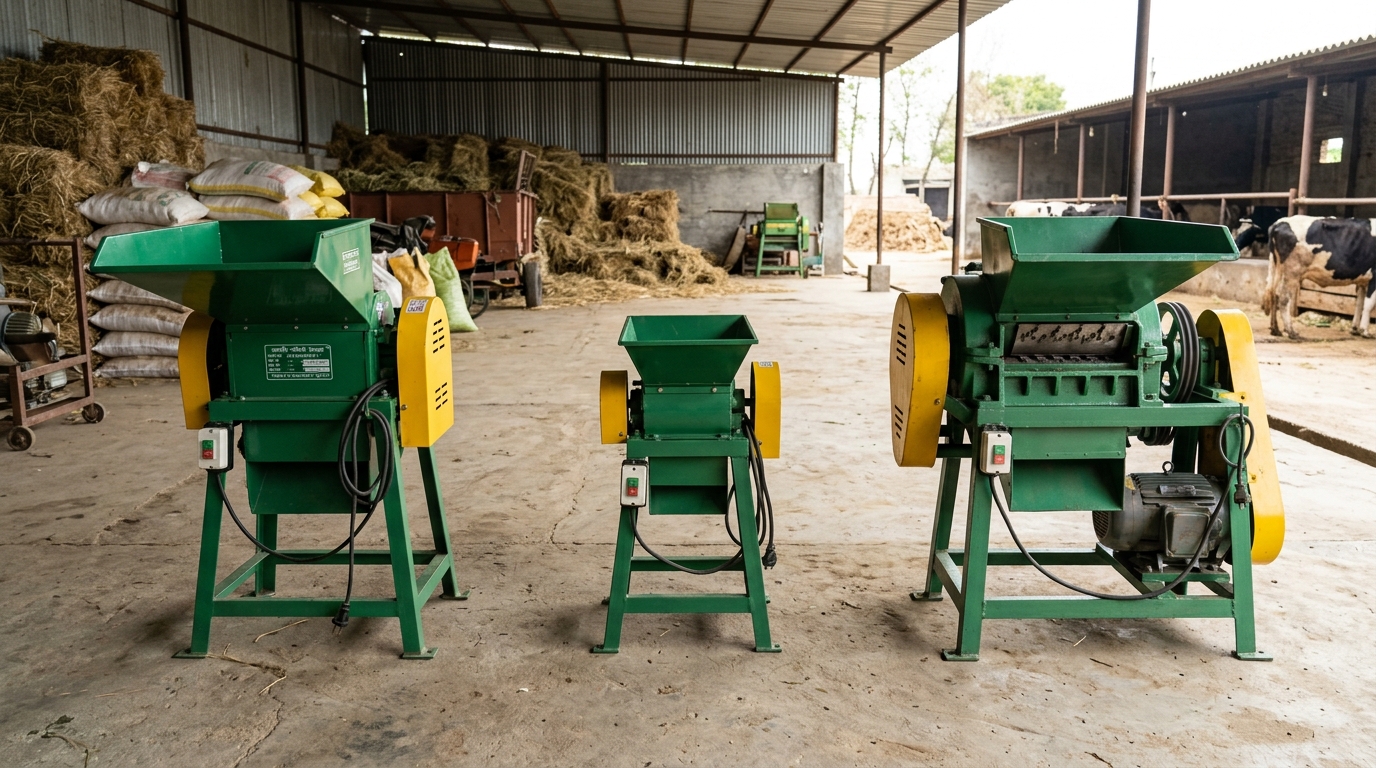
Choosing a chaff cutter isn't just about horsepower — it's about matching the machine to your herd size, your electricity connection, and how much fodder you actually need to process in a day. AgriFuture India manufactures four distinct chaff cutter models, each built for a different scale of operation. This guide breaks down exactly what separates them, so you're not overpaying for capacity you don't need — or underbuying for a herd that's about to outgrow a small machine.
The Quick Answer
- Small herd (2–5 animals), tight budget: Gokul Model
- Small-to-mid herd, single-phase power only: Blower Chaff Cutter
- Mid-size dairy, want flexibility on power type: High Neck Chaff Cutter
- Large commercial dairy or fodder business: Big Brother Chaff Cutter
Meet the 4 Models

1. Big Brother Chaff Cutter — Built for Volume
This is AFI's flagship, high-output machine, designed for large dairies, gaushalas, and commercial fodder operations that need to process large volumes fast.
The conveyor belt is the standout feature here — it lets one operator feed fodder continuously without manually pushing material in batches, which is the main bottleneck on smaller machines when cutting at scale.

2. High Neck Chaff Cutter — The Flexible Mid-Range Option
Built for mid-size dairies that want room to choose their power setup and blade configuration.
This is the most configurable machine in the range — buyers choose both their power type and blade count independently, which makes it a good fit for farms that aren't sure yet whether they'll upgrade their electrical connection soon, or who want to start with a 3HP single-phase unit and scale to 5HP later.

3. Blower Chaff Cutter — Single-Phase Simplicity
Designed for farms running on single-phase power only, with no need for 3-phase capacity.
The "blower" design typically helps throw cut fodder clear of the outlet, useful for direct loading into a cart or feed trough. This sits between the Gokul and High Neck models in output, and is a strong fit for farms that have single-phase power only but need more than entry-level capacity.

4. Gokul Model Chaff Cutter — Entry-Level and Compact
AFI's smallest and most affordable chaff cutter, aimed at small dairy holders and first-time buyers.
Lower power draw and compact footprint make this the easiest machine to run on a basic domestic-style power connection, and the lowest upfront cost in the range.
Comparison Table
| Model | Capacity | Motor | Power Type | Blade Options | Price Tier | Best For |
|---|---|---|---|---|---|---|
| Gokul Model | 800 kg | 2HP | Single phase | 2 or 3 blade | ₹ | 2–5 animals, entry-level |
| Blower | 1.5 ton | 3HP | Single phase | 2 or 3 blade | ₹₹ | 8–15 animals |
| High Neck | 2 ton | 3HP or 5HP | Single or 3 phase | 2 or 3 blade | ₹₹₹ | 10–25 animals, flexible setups |
| Big Brother | 7 ton/hour | 5HP | 3 phase | 5 blade + conveyor | ₹₹₹₹ | 30+ animals, commercial |
* Price tiers are relative (Gokul is the most affordable, Big Brother the most premium) — exact pricing depends on blade configuration and is available on request.
What Actually Matters When Choosing
1. Your Power Connection
This is the first filter, before capacity even matters. If your farm only has a single-phase connection, that immediately rules out the Big Brother and the 5HP High Neck variant. The Gokul, Blower, and 3HP High Neck all run on single phase. If you're planning to upgrade to a 3-phase connection soon, the High Neck's dual motor option lets you buy once and match your future power setup rather than replacing the machine later.
2. Herd Size vs. Machine Capacity
Buying more capacity than you need means paying for horsepower and motor durability you'll rarely use. Buying less means your operator spends more time cutting fodder than actually feeding and managing the herd. As a rough rule: match daily fodder need to machine capacity with some headroom for growth, not the exact number you need today.
3. Blade Count
Across the Blower, High Neck, and Gokul models, buyers choose between 2-blade and 3-blade configurations:
- 2-blade: Slightly coarser cut, generally lower cost, less frequent sharpening needed.
- 3-blade: Finer, more uniform cut — often preferred for silage-bound fodder or animals that do better with shorter chaff length — at a modestly higher price point.
4. Feeding Method
Only the Big Brother includes a conveyor belt. For every other model, fodder is fed manually. If you're processing large daily volumes even on a mid-size herd (for example, supplying cut fodder to other farms), the labor savings from the conveyor may justify the step up even if your herd size alone wouldn't.
5. Build Quality
The Big Brother's pure copper motor winding is a durability marker worth noting — copper windings generally run cooler and last longer under continuous heavy use than lower-grade alternatives, which matters for a machine expected to run for extended hours in commercial settings.
Still Not Sure Which One Fits?
Tell us your herd size, your power connection type, and how many hours a day you expect to run the machine — our team can recommend the right model and blade configuration for your specific setup.
FAQs
Equip Your Farm with AgriFuture India
Manufacturer-direct pricing on HDPE Plastic Goat Slats, Heavy-Duty Chaff Cutters, Cow Rubber Mats, and 100% Virgin Silage Bags.